
01
Dent Repairs
Minor dings, door dents and hail damage repaired on the same day. Paintless techniques used wherever the finish is intact — conventional repair where the metal has stretched or cracked.
Get A QuoteBuilt on reputation and quality of work. Twenty-five years of accident repairs, colour-matched resprays and PDR from the same workshop on Eastern Avenue. Dealer quality finish without the shortcuts or upselling.
>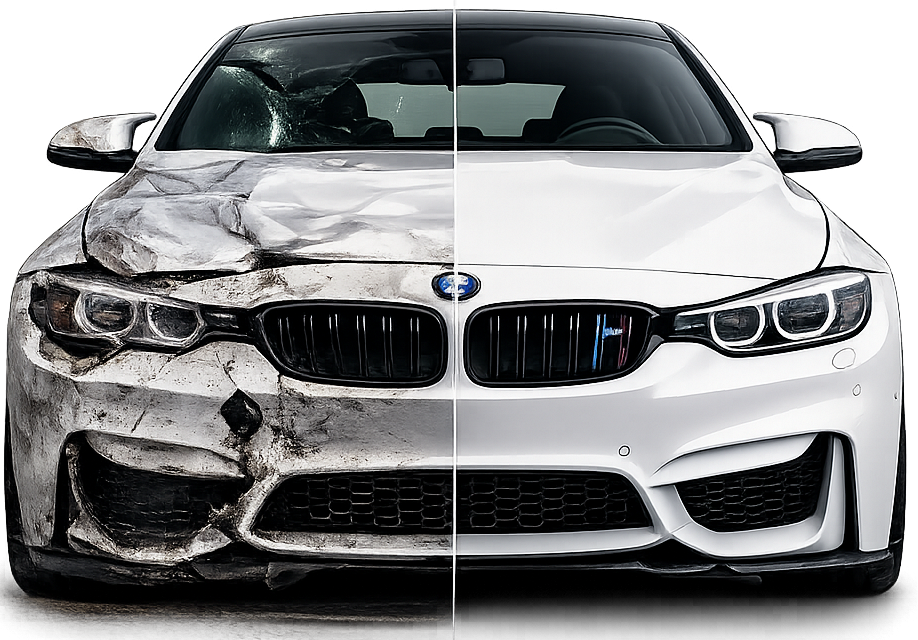
We opened our doors on Eastern Avenue in the year 2000 with two spray booths, one paint mixer and a stubborn belief that a dent repair should look as if the dent never happened. Twenty five years later we still mix every colour on site, we still measure every panel gap with a feeler gauge, and we still hand every job back personally.
Our regulars include leasing fleets, Audi owners from across the capital, classic restoration projects, and drivers who simply want their car looking right again after a bad week.
Five core disciplines under one roof in Ilford. Every job priced on inspection — not from a call centre script.
Minor dings, door dents and hail damage repaired on the same day. Paintless techniques used wherever the finish is intact — conventional repair where the metal has stretched or cracked.
Get A QuoteFrom low-speed scrapes to comprehensive crash damage. Structural assessment on the jig before any panel work begins. We liaise directly with your insurer and manage the full repair process.
Get A QuoteStripped to bare metal, corrosion treated, primed, flatted, colour coated and lacquered. Classics, Audis and prestige vehicles returned to showroom condition — factory finish, factory gaps.
Get A QuoteWings, doors, sills, bonnets, tailgates — straightened where possible, replaced where not. Every repair refinished to a verified colour and texture match with panel gaps checked before and after.
Get A QuoteCracked, scuffed or split bumpers reshaped, bonded and refinished. Flexible primer applied before colour coat to prevent cracking. Colour blended into surrounding panels for a seamless result.
Get A QuoteBring the car in. We assess damage with paint meter and feeler gauge and give you a written quote in fifteen minutes.
We walk you through the options. If insurance is involved we lodge the claim and deal with the engineer for you.
Work is carried out on site. Paint is mixed to your factory code, sprayed in a downdraft booth and fully baked.
We polish, road test and walk the car around with you before you drive away. Warranty certificate included.

330 Eastern Avenue, Ilford IG4 5AA — Monday to Saturday, 09:00–18:00
Straight answers to the questions we get asked most often — costs, timelines and what actually happens to your car when it comes in for repair.
A customer pulled up last Tuesday in a white A3 with a ten pence sized dent on the rear door. She wanted one number before she left the forecourt. The honest answer is that a dent repair in London can cost anywhere from ninety five pounds to eight hundred pounds depending on five things, and a responsible body shop will not quote you over the phone without seeing the car.
Here is what actually drives the number. The size of the dent matters less than people assume. A small shallow dimple with untouched paint is the cheapest job in the shop because we can massage it out from behind the panel without touching the finish. That is paintless dent removal and it tends to sit in the ninety five to one hundred and sixty pound range per dent. Once the paint has cracked or the metal has stretched, we cross into conventional repair territory and the cost climbs.
A golf ball sized dent on a front wing with flaked paint usually runs between two hundred and eighty and four hundred and fifty pounds. That covers pulling the dent, skimming a thin layer of lightweight filler, flatting, priming, colour coating, lacquering and baking the panel in the booth. We then blend the fresh paint into the neighbouring panel to kill any chance of a colour step. If the dent sits on a body line or a swage, the price creeps upward because a reshaped edge takes more time to get right than a flat face.
Pillars, tailgates and aluminium panels are the three that add cost. Aluminium work needs a separate bench and separate tools so the steel dust never cross contaminates. Tailgates often carry badges, wipers and wiring that have to come off cleanly. Pillar work usually means rebonding trims that were glued at the factory with adhesives that modern body shops do not always stock. Ask for a breakdown of what is panel time and what is paint time when the quote comes in and you will immediately see where the pound notes are going.
Most dents under five hundred pounds are cheaper to pay out of pocket than to claim. You protect your no claims discount, you avoid the excess, and the job is usually finished inside the week. Once you move above a thousand pounds or damage crosses more than two panels, running the repair through your insurer stops being a question and becomes the practical choice. We are on the approved network for the main UK insurers so we can lodge the claim on your behalf, handle the engineer visit and supply a courtesy arrangement while the car is in the booth. If you want a sense of where your job sits, read our piece on bodywork repair costs or drop in with the car any weekday morning and we will give you a written quote in about fifteen minutes.
Both of us have been asked the mobile versus workshop question more times than we can count, usually by someone holding up a phone with a photo of a crease down a passenger door. The short version is that a good mobile technician can do excellent work on a narrow range of jobs, and that a workshop is the right choice the moment the job steps outside that range. The reason lies in the tools, the lighting and the physics of paint.
A mobile operator arrives in a van. That van carries a toolbox of rods and glue tabs, a portable light board, and sometimes a small paint mixing setup. It does not carry a booth, a downdraft filter, a heated cure cycle, a jig or the kind of overhead lighting that reveals a colour mismatch before the customer does. For dents that do not need paint that limitation is fine. The repair is metal only, the finish is untouched, and the van can produce a result on your driveway that looks the same as the one we would produce in the booth.
Paint changes the equation. The moment a dent has cracked lacquer, missing colour or stretched metal, the job needs a filler stage, a primer stage, a basecoat stage and a lacquer stage. Each of those stages needs air filtration, controlled temperature and clean overhead light. Spray a metallic silver outside on a windy day and you will see flake orientation issues within a week. Spray it inside a downdraft booth at twenty two degrees with regulated air flow and the finish matches the factory. That is not a marketing line. It is the reason insurance networks do not approve mobile operators for paint work.
The second boundary is structural. Any repair that touches sills, pillars, chassis rails, crumple zones or bonded aluminium sections must be done on a measured bench. Mobile does not have a bench. If a technician straightens a structural panel on a driveway, the geometry is guessed rather than measured, and the car can leave with panel gaps that look fine but track slightly offline under braking. We have corrected driveway repairs on otherwise healthy cars three or four times a year. It is avoidable damage.
Walk around the car. If the damage is one dent, one panel, untouched paint and smaller than a tennis ball, mobile is a legitimate route and the cost should be lower. Ask for photographs of recent work in the same colour as your car, and ask whether the quote includes a guarantee. If the damage involves paint, more than one panel, structural metal, a body line or an aluminium panel, book into a workshop. The price difference is usually smaller than drivers expect, and the long term finish is measurably better. See our notes on why paintless dent repair works only for small dents for the technical reasoning behind the boundary.
The first paintless dent I ever pulled was on the boot lid of a Mark Four Golf in 2003. A tennis ball had landed on it from the top of a block of flats and left a clean round dimple the size of a pound coin. I worked a rod up through the boot hinge, pushed the centre of the dimple out in slow circles, tapped the high points back down with a plastic peck hammer, and the repair was invisible in under an hour. Paintless dent repair is a beautiful technique when the dent fits its boundaries. It falls apart the moment those boundaries are crossed.
The method relies on the metal remembering its original shape. Sheet steel has a kind of memory within an elastic range. Push it gently and it springs back. Push it past that range and the metal stretches. Stretched metal does not go back to its original surface even when the visible dent is gone, because the volume of metal in that area is now slightly greater than the space the panel was designed to hold. That shows up as a wave, a low spot, or a ripple under fluorescent light. Paintless tools cannot unstretch metal.
The first sign is a sharp crease. If you run your finger across the dent and feel a hard edge where the metal folded in on itself, the paint on that edge is almost always cracked even when it looks fine from two metres away. A cracked lacquer lets moisture into the primer within weeks and rust follows by the second winter. A conventional repair with filler, primer, colour and lacquer is the safe route. The second sign is a large shallow dent that covers a body line. Body lines are a designed step in the panel geometry. Once the step is reshaped by an impact, you cannot rebuild the original crisp angle from behind. You can only rebuild it on the surface with a thin skim of filler. The third sign is damage near the edge of a panel. Paintless needs access from behind and the edges of panels sit against frame rails and bracketry that block the rods.
A paintless repair that looks acceptable on the day can reveal itself six months later when sunlight hits the panel at the right angle and the waves appear. Doing the same dent properly with filler and paint takes three days and costs more, but it produces a panel that looks flat and holds its finish for years. We turn away paintless jobs that belong in the booth every week, because a weak repair on our site damages our reputation far more than it helps the day ticket. If you are weighing up options on a larger dent, have a read of our article on how much a dent repair costs and then bring the car in.
A full restoration after an accident is a different animal to a bumper scuff. When a car arrives at our workshop on the back of a transporter after a serious shunt, the first hour is not spent thinking about paint. It is spent lifting the car onto the bench, running a laser alignment and deciding whether the structural geometry can be pulled back to factory tolerance. If it can, the rest of the project becomes ambitious but rational. If it cannot, the car becomes a repair estimate the insurance engineer will almost certainly write off. That decision made at hour one drives everything else.
Once the geometry passes, we strip the car back to bare affected panels and identify every deformed, torn or bonded section. Modern vehicles mix steels of different strengths in the same shell. A rail made from ultra high strength steel cannot be hammered back. It is cut out at the manufacturer approved weld seams and replaced with a new section bonded and spot welded to the same map the factory used. The second section, often the inner wing or crumple zone, is pulled with controlled hydraulic force until the measured points return to specification. The bench does not lie. If the numbers are not right, the car goes back on the rams until they are.
Paint cannot begin until the structural phase is closed out. New panels arrive in primer or bare metal and each one is etch primed, filled where needed, flatted to 400 grit and high build primed before the colour coat. Our mixer room holds the current PPG water based formulas and we keep the older Glasurit solvent range for the cars that still warrant it. The colour is spectrophotometer matched to the existing factory panel, tested on a card, corrected if needed, then sprayed in the booth at twenty two degrees with regulated flow. Clear coat follows in two coats with a full bake cycle. The blend into the surrounding panels removes any chance of a colour step, which is the only reason modern repairs look invisible in daylight.
The final week of a full restoration is usually the quiet one the owner does not see. We refit all badges, trims, seals and lighting with new clips where old clips have aged. We road test the car ourselves across motorway and urban routes to prove the geometry feels right under braking and camber change. We polish the paint with a dual action machine and a fine cutting compound to even out any micro variations between the new panel and the neighbouring originals. When the car leaves the workshop, the owner gets a folder with before and after measurements, the paint code, the warranty paperwork and our direct phone number. For anyone weighing up whether their car is worth restoring or writing off, our piece on bodywork repair costs gives a useful ballpark before you come in.
Every week a driver walks into reception with a photograph and asks what the repair will cost. The honest answer is that bodywork pricing looks like a staircase, not a scale. There are clear steps, and where your job lands on the staircase decides the number far more than the size of the damage. After twenty five years on Eastern Avenue we can give you the staircase without seeing the car, and then we tighten the quote down to the pound once the car is on the ramp.
Step one is paintless dent repair. A single clean dent on untouched paint, anything from a car park nick to a football sized dent with no cracking, sits between ninety five and one hundred and seventy pounds. Step two is a small panel blend. A scuffed bumper corner, a keyed door panel under a hundred millimetres, a grazed wing tip. These run between two hundred and forty and four hundred and fifty pounds because they need paint mixing, masking, spray time and a bake. Step three is a full single panel respray. A whole door, a whole wing, a bonnet or a tailgate refinished corner to corner. Expect between four hundred and fifty and eight hundred pounds for most mainstream cars, with a small premium for metallic and pearlescent colours because they need an extra coat and a more careful blend.
Step four is a multi panel repair with body filler and blending. Most insurance claims land here. Two adjacent panels with real damage, a bumper, a wing, a door and a rear quarter after a side swipe. These sit between nine hundred and eighteen hundred pounds in the current London labour market, with prestige cars pulling the figure upward because their body panels require specific bonding adhesives and their paint codes sometimes need a hand blended tint. Step five is a structural repair. Bench work, rail replacement, welded panels, geometry correction. Anything in this territory is almost always two thousand pounds plus and usually runs through insurance rather than out of pocket because engineer approval is part of the process.
Three variables matter. Colour complexity is the first. Pearl whites, tri stage blacks and candy reds need more spray time and more match work than a solid metallic silver. Age of the car is the second. Older cars with original paint sometimes need paint rejuvenation on neighbouring panels to avoid a colour step that otherwise reveals the repair under sunlight. Parts availability is the third. If a specific trim clip or a wing mirror cap has to ship from Ingolstadt, the lead time and the part cost both go up. We share the breakdown in writing so you can see where the pound notes sit, and we tell you honestly when paying from your own pocket saves more than claiming through your insurer. Our write up on location of damage and extent of work involved explains the next variable in more detail.
Two dents that look identical in a photograph can cost four times apart once they are on the ramp. The reason is almost always where the damage sits on the car rather than how deep it is. A large dimple on a bonnet is cheaper than a small one on a fuel filler surround, and a six inch crease on a door outer skin is cheaper than a one inch dent on a quarter panel with an integrated body line. Drivers rarely hear this on the forecourt and then feel blindsided when the quote arrives. The purpose of this piece is to give you the real logic before you step into any workshop.
Start with access. Behind every panel there is either open space, a layer of sound deadening, a crash bar, a bonded reinforcement, or a sealed cavity. Paintless work needs access from behind, so panels with open space behind them are the cheapest to repair. Bonnets and boot lids fall into that group. Doors sit one tier up because the inner skin and the window regulator limit how far the rod can travel. Quarter panels are the hardest because they are usually welded and sealed at the factory, so conventional repair with filler and paint becomes the only route even for a small dent.
The second factor is the shape of the panel under the dent. Flat panels are forgiving. A gentle convex curve is straightforward. A sharp body line with a tight crease in the sheet metal is the hardest geometry to restore because the line has to read as a single continuous edge from front of the car to back. If the line steps by half a millimetre, daylight catches it and the repair stops being invisible. Panels with compound curves near the rear arches, around wheel openings and under tail light clusters take longer to finish and therefore cost more to refinish properly. The tools do not change. The time does.
Extent is the last factor and it is the one most drivers underestimate. A damaged wing often means removing the front bumper, the front headlight, the arch liner and sometimes the wheel to give the technician clean access. A damaged rear door means removing the trim card, the speaker, the window guide and the electrical connectors without breaking any of them. None of that removal shows in the finished repair but every minute of it sits inside the invoice. The same is true of masking. A small dent in the middle of a complex panel can require an hour of masking around door shuts, window rubbers, badges and stone guards before the first coat of paint goes on. This is why we always assess the car in person before we give you a final quote. A photograph tells us where the damage is, but only the car on the ramp tells us what the job really involves. Pair this piece with our guide on bodywork repair costs and you will walk into any quote conversation ready to ask the right questions.
Most paintless dent repairs take between one and three hours on site. A dent that requires filler, blending and a bake through the booth usually needs one to three working days depending on panel size and colour complexity.
Yes. We are insurance approved for bodywork and accident repairs. We handle the assessment, liaise with your insurer and engineer, and provide courtesy transport where your policy allows it.
We are a recognised Audi bodywork partner. We use Audi approved methods, OEM fixings and the correct paint codes so the repair matches the factory finish and preserves corrosion warranty.
A small paintless dent on a flat panel typically starts around £95. A dent that needs filler and a single panel respray usually falls between £280 and £450. Complex multi panel damage is quoted after inspection.
Our workshop is at 330 Eastern Avenue, Ilford IG4 5AA. We are easy to reach from the A12, the North Circular and the Central line. Parking for drop off is available directly outside the unit.
Free written quote in fifteen minutes. No appointment, no pressure, no hidden add ons.